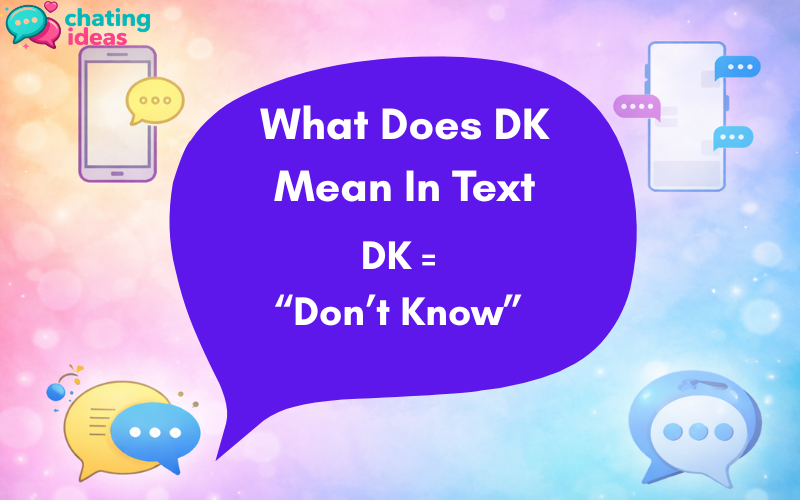

If you are asking what does DK mean in text, the simple answer is this: DK usually means “Don’t Know.” People use it when they do not know the answer to something. It is a short and easy word used in chats, text messages, and social media.
Today, people use many short words when they talk online. These words help them type fast and keep messages short. You may see words like LOL, DW, ETA, and STFU. DK is also one of these common texting words. It is simple, useful, and very easy to understand once you know the meaning.
Many people see “DK” in a message and feel confused. They may not know if it means a place, a name, or a short form. In texting, the meaning is usually very simple. In most chats, DK means that the person does not know something.
In this article, you will learn everything about DK in very easy English. You will learn its meaning, where people use it, how to use it, when to avoid it, and many real examples. Everything is explained in a simple way so anyone can understand it.
What Does DK Mean in Text? (Easy Explanation)
DK means “Don’t Know.”
People use DK when they do not know an answer, are not sure about something, or do not have information. It is a very common reply in texting because it is short and fast.
For example, if someone asks:
👉 “What time is the meeting?”
You can reply:
👉 “DK”
This means:
👉 “I don’t know.”
So, when you see DK in a text, it usually means the person is saying they do not know the answer. It is just a shorter and quicker way to say the full sentence.
Related Post: What Does IFY Mean in Text? Simple Meaning, Uses, Examples, and Easy Guide
DK Meaning in Text (Quick Table)
| Term | Meaning | Use in Text | Example |
|---|---|---|---|
| DK | Don’t Know | Used when you do not know something | DK what happened |
| Don’t Know | Full form of DK | Used in normal writing and speech | I don’t know the answer |
| DK (Slang) | Casual texting short form | Used in chats and social media | DK where he went |
What Does “Don’t Know” Mean?
“Don’t know” means you do not have the answer or information. It is used when someone asks you something and you are not sure, or you really have no idea.
For example, if someone asks where your friend is and you do not know, you can say, “I don’t know.” In texting, many people shorten this to DK. The meaning stays the same, but the message becomes shorter and faster to type.
This phrase is very common in daily life. We all use it when we are unsure about a person, place, time, or answer. That is why DK is also very common in online chats. It is a simple reply that works in many situations.
In easy words, “don’t know” can mean:
- I have no idea
- I am not sure
- I do not have the answer
- I do not have the information
So, DK is simply a short texting version of all these ideas.
Why Do People Use DK?
People use DK because it is very quick. In online chats, people do not always want to type full sentences. Instead of writing “I don’t know,” they just write DK. It saves time and effort.
Another reason is that DK is easy to understand. Many people already know this short form, so it works well in daily chats. It is one of those small internet words that can make texting faster without changing the meaning.
DK is also useful because it fits many situations. You can use it when someone asks a question, when you are confused, or when you are not sure about a plan. Because of this, it is a flexible texting word.
People also use DK because chats are often casual. In casual messages, short words feel natural. That is why DK is common on WhatsApp, Instagram, Snapchat, and text messages.
Where Do People Use DK?
DK is used in many places where people chat online. One of the most common places is WhatsApp. Friends and family often use DK in quick daily conversations when they do not know something.
It is also used on Instagram and Snapchat. People use it in private messages, story replies, and casual chats. Since these apps are fast and informal, short words like DK are very common there.
You may also see DK in online games. Gamers often chat while playing, so they like short words that are easy to type. If one player asks a question and another does not know the answer, they may simply reply with DK.
DK is also common in text messages and group chats. In school groups, friend groups, or family chats, it can be used whenever someone does not know the answer. It is one of those short forms that fits many kinds of conversations.
How to Use DK in Text (Step-by-Step)
Using DK is very easy. First, look at the message you received. If someone asks you a question and you do not know the answer, you can use DK as a reply.
For example, if someone asks, “Where is Ali?” and you do not know, you can reply with “DK.” This is the shortest way to answer. If you want to sound a little more natural, you can also write “DK lol” or “DK tbh,” depending on the conversation.
You can also use DK in the middle of a sentence. For example:
👉 “DK if he is coming”
👉 “I DK what happened”
In some chats, people write only “DK.” In other chats, they write a longer message with DK inside it. Both ways are common in texting.
Easy Examples of DK
Here are some simple examples to help you understand how DK is used in real messages.
Example 1:
A: Where is Sara?
B: DK
Example 2:
A: What time is the class?
B: DK, maybe 2 PM
Example 3:
A: Did he call you?
B: DK, I didn’t check my phone
Example 4:
A: Are we going out today?
B: DK yet
These examples show that DK is used when someone does not have an answer. Sometimes it is used alone, and sometimes it is used in a longer sentence.
Different Ways to Use DK in a Sentence
DK does not always have to be used alone. You can also use it in a full sentence to make your message more clear. This is very common in texting.
For example, you can write:
- I DK where he went
- DK if she is coming
- We DK the answer
- They DK what happened
These sentences still keep the message short, but they also add a little more information. This can help the other person understand your reply better.
Some people also write “idk,” which means “I don’t know.” That is another common texting word. DK and IDK are very close in meaning, but IDK is used even more often in some chats.
Make Your Messages Better
You can make your DK replies sound better by adding a few extra words. This makes your message feel more natural and helpful.
For example, instead of only writing “DK,” you can write:
- DK, maybe ask him
- DK right now
- DK yet, I’ll check
- DK sorry
These small additions make the reply softer and more friendly. They also give the other person more information.
You can also add emojis if the chat is casual. For example:
- DK 🤷
- DK 😅
- DK lol
This can make the conversation feel lighter, especially when you are chatting with friends.
When Should You Use DK?
You should use DK in casual chats when you do not know the answer to something. It works best in messages with friends, family, classmates, or people you talk to every day.
It is useful when someone asks you about a plan, a person, a time, or any information that you do not know. Instead of typing a full sentence, you can simply use DK.
DK is also good when you want to reply quickly. If the chat is fast and informal, DK feels natural. It keeps the conversation moving without making your message too long.
You can also use DK in group chats. For example, if someone asks, “Who is bringing the cake?” and you do not know, DK is a quick and simple reply.
When Should You NOT Use DK?
DK is not a good choice in formal writing. You should avoid using it in office emails, professional messages, school assignments, or official communication.
In these places, it is better to write the full words: “I don’t know.” This looks more professional and clear. Short forms like DK can look too casual in formal situations.
You should also be careful if the other person may not understand internet slang. For example, older people or someone who does not text much may not know what DK means. In that case, using the full phrase is a better idea.
Another time to avoid DK is when the situation is serious. If someone is asking an important question, a full answer may be more respectful than a one-word reply.
DK vs IDK: What Is the Difference?
Many people confuse DK and IDK because they are very similar. Both are used when someone does not know something, but there is a small difference in how they sound.
DK = Don’t Know
IDK = I Don’t Know
DK is shorter and more basic. IDK sounds a little more complete because it includes “I.” In many chats, people use IDK more often than DK because it feels more natural as a full reply.
For example:
- DK where he is
- IDK where he is
Both mean almost the same thing. The second one just sounds a little more complete. Still, DK is used by many people and is easy to understand in casual chats.
Other Meanings of DK
In texting, DK usually means “Don’t Know.” That is the meaning most people use in messages. But in other places, DK can have different meanings, so context matters.
For example, DK can sometimes stand for Donkey Kong, which is the name of a video game character. In some cases, it can also mean Denmark as a country code or abbreviation. But these meanings are not usually used in normal texting conversations.
That is why the full message is important. If someone says, “DK where he went,” it clearly means “Don’t Know.” But if someone says, “I love DK games,” the meaning may be different.
So, always look at the sentence before deciding the meaning of DK.
DK vs Other Chat Words
DK is often used with other short texting words. Knowing the difference between them can help you understand chats better.
DK vs IDK
- DK = Don’t Know
- IDK = I Don’t Know
Both are almost the same, but IDK is more common in many chats.
DK vs TBH
- DK = Don’t Know
- TBH = To Be Honest
DK is used when you do not know something. TBH is used when you want to say your honest opinion.
DK vs IDC
- DK = Don’t Know
- IDC = I Don’t Care
These are very different. DK means you do not have the answer. IDC means you do not care about the topic.
More Common Chat Words
Here are some other short texting words you may see online:
- LOL = Laugh Out Loud
- BRB = Be Right Back
- TY = Thank You
- YW = You’re Welcome
- DW = Don’t Worry
- ETA = Estimated Time of Arrival
- LWK = Low Key
- STFU = Shut The F*** Up
- IDK = I Don’t Know
Learning these words can make online chatting much easier. They help you understand messages faster and reply more naturally.
If you are new to texting slang, do not worry. You do not need to learn everything in one day. Just learn one word at a time, and soon these short forms will feel easy.
Real-Life Chat Examples
Here are more real-life style examples of DK in texting.
Example 1:
A: What is the homework?
B: DK, I missed class
Example 2:
A: Is he coming with us?
B: DK yet
Example 3:
A: Why is she upset?
B: DK, maybe ask her
Example 4:
A: Who posted that story?
B: DK honestly
Example 5:
A: What time is the movie?
B: DK, check the app
These examples show that DK can be used in many different situations. It is simple, flexible, and very common in casual chats.
Is DK Good or Bad?
DK is a good and harmless texting word. It is not rude, offensive, or negative by itself. It is simply a short way to say that you do not know something.
The only problem is when it sounds too short in an important conversation. For example, if someone asks a serious question and you only reply “DK,” it may feel cold or lazy. In that case, it is better to write a full sentence.
But in normal chats with friends, DK is completely fine. It is quick, clear, and easy to understand. That is why many people use it every day.
So, DK is not a bad word. You just need to use it in the right place and in the right tone.
Is DK Still Used Today?
Yes, DK is still used in 2026. It may not be as famous as LOL or IDK, but people still use it in texting and casual online chats.
Short words are still a big part of internet communication. People want to type quickly, and words like DK help with that. Even though some people prefer IDK, DK is still seen in many conversations.
It is especially common in friend groups, gaming chats, and fast conversations where people want to reply in one or two words.
So yes, DK is still used today, and it is still useful to know if you want to understand modern texting language.
Why You Should Learn DK
Learning DK is useful because it helps you understand common online messages. If someone replies with DK and you do not know the meaning, the conversation can feel confusing.
It also helps you reply faster. Instead of typing “I don’t know” every time, you can simply write DK in casual chats. This saves time and makes texting easier.
Another reason to learn DK is that it helps you understand other slang words too. Once you get used to short forms like DK, words like IDK, DW, ETA, and LWK also become easier to learn.
So, even though DK is a very small word, it is still worth learning because it makes online communication simpler and faster.
Easy Trick to Remember DK
You can remember DK with a very simple trick:
👉 D = Don’t
👉 K = Know
So:
👉 DK = Don’t Know
That is all you need to remember. The next time you see DK in a chat, you will know it means the person does not know something.
You can also connect it with a simple sentence:
👉 “DK the answer” = “Don’t know the answer”
This makes it even easier to remember.
Common Mistakes
Some people make small mistakes when using DK. One common mistake is using it in formal writing, like school work or office emails. In those places, it is better to write the full phrase “I don’t know.”
Another mistake is confusing DK with IDK. They are similar, but not exactly the same. DK means “Don’t Know,” while IDK means “I Don’t Know.” Both are fine in chats, but you should understand the difference.
Some people also use DK in a way that sounds too dry. For example, if a friend asks an important question and you only reply “DK,” it may sound careless. In that case, writing a little more can make your message better.
So, DK is easy to use, but it still helps to think about the situation and tone.
Hope you liked this guide. Check out these related articles too:
- What Does LAMO Mean in Text? Simple Meaning, Uses, Examples, and Easy Guide
- What Does YOLO Mean in Text? Simple Meaning, Uses, Examples, and Easy Guide
- What Does BFFR Mean in Text? Simple Meaning, Uses, Examples, and Easy Guide
- What Does WTD Mean in Text? Simple Meaning, Uses, Examples, and Easy Guide
- What Does WTMS Mean in Text? Simple Meaning, Uses, Examples, and Easy Guide
FAQs
What does DK mean in text?
DK means “Don’t Know.” People use it when they do not know the answer to something.
Is DK the same as IDK?
Not exactly. DK means “Don’t Know,” while IDK means “I Don’t Know.” They are very similar, but IDK is a little more complete.
Is DK rude?
No, DK is not rude. It is a simple and normal texting word. But if you use it alone in a serious conversation, it may sound a little cold.
Can I use DK in school or office emails?
It is better not to. In formal places, use the full phrase “I don’t know.”
Is DK still used today?
Yes, DK is still used in texting and casual online chats in 2026.
Other Texting Slang Words You Can Learn
If you want to learn more words like DK, there are many other short words people use in chats every day. These words are easy to learn and help you understand texting language better.
You can read about what does DW mean in text, what does STFU mean in text, what does ETA mean in text, and what does LWK mean in text. Learning these words will help you understand messages faster and reply more easily.
If you enjoy learning chat slang, these related guides can help you build a strong understanding of common internet words and texting shortcuts.
Related Post: What Does IFY Mean in Text? Simple Meaning, Uses, Examples, and Easy Guide
Conclusion
Now you understand what does DK mean in text. In most chats, DK means “Don’t Know.” People use it when they do not know an answer, are unsure about something, or do not have the information. It is short, simple, and very common in texting.
DK is useful because it saves time and makes casual conversations faster. You can use it with friends, in group chats, and in everyday messages. But remember, it is better to avoid DK in formal writing like school work or office emails. In those places, writing the full phrase is the smarter choice.
If you keep learning small chat words like DK, texting will become much easier for you. These short forms may look confusing at first, but once you know them, they are very simple to understand and use.