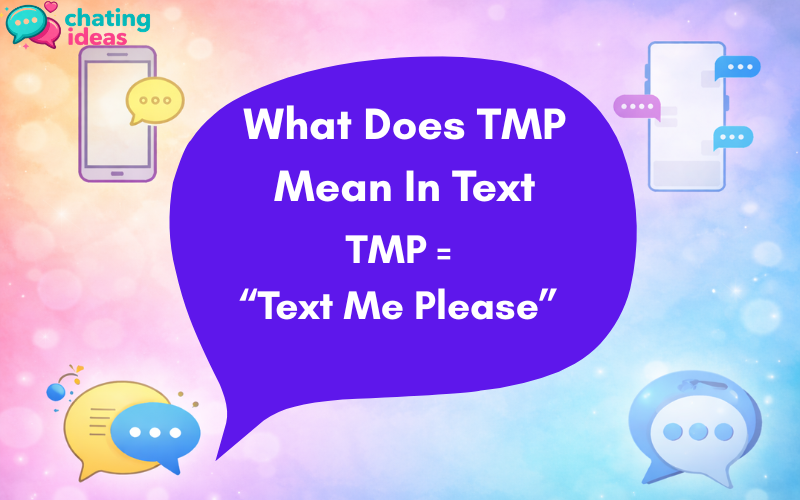

If you are asking what does TMP mean in text, the simple answer is this: TMP usually means “Text Me Please.” People use it when they want someone to send them a message. It is a short and easy texting word used in casual chats.
Today, people use many short words when they talk online. These short words help them type faster and keep messages small. You may see words like LOL, ETA, LWK, and DW. TMP is another short word that people use in text messages, social media chats, and group conversations.
Many people see “TMP” and feel confused because it is not as common as some other texting slang. Also, TMP can have more than one meaning in different situations. That is why context is important. You need to read the full message to understand the right meaning.
In this article, you will learn everything about TMP in very easy English. You will learn its most common meaning, other possible meanings, how to use it in text, where people use it, and many simple examples. By the end, you will understand TMP clearly and know when to use it in your own chats.
What Does TMP Mean in Text? (Easy Explanation)
TMP usually means “Text Me Please.”
People use TMP when they want someone to message them. It is a quick way to ask for a text without writing the full sentence. Instead of typing “Text me please when you get home,” a person may simply write “TMP when you get home.”
This short form is mostly used in casual texting. It is common in conversations between friends, family members, classmates, or people who already talk often. It sounds simple and saves time, especially when someone is in a hurry and wants a fast reply.
For example, if a friend says they are going out, you might say:
👉 TMP when you arrive
This means:
👉 Text me please when you arrive
So, if you are wondering what does TMP mean in text, the most common answer is “Text Me Please.”
Related Post: What Does BFN Mean in Text? Simple Meaning, Uses, Examples, and Easy Guide
TMP Meaning in Text (Quick Table)
| Term | Meaning | Use in Text | Example |
|---|---|---|---|
| TMP | Text Me Please | Used to ask someone to send a message | TMP when you get home |
| Text Me Please | Full form of TMP | Used in casual chats | TMP later |
| TMP (slang) | A quick texting request | Used in messages and social media chats | TMP after class |
What Does “Text Me Please” Mean?
“Text me please” is a simple request. It means the speaker wants the other person to send a text message. The message can be about anything, but usually it is used when someone wants an update, an answer, or a quick reply later.
For example, if your friend is busy right now and cannot talk on a call, you may say, “TMP when you are free.” This means you want them to send you a message later. It is a polite and easy way to ask for contact without sounding too serious.
Sometimes people use “text me please” because they want to know if someone reached home safely. Sometimes they use it because they want to continue the conversation later. In both cases, the meaning is simple: send me a message when you can.
So, when TMP means “Text Me Please,” it is all about asking for a message in a quick and casual way.
Why Do People Use TMP?
People use TMP because it is short, easy, and fast. In texting, many people do not want to type long sentences again and again. They like small words that save time. TMP does exactly that. It turns three words into just three letters.
Another reason people use TMP is convenience. If someone is busy, walking, traveling, or doing something else, they may want to send a quick message. Typing TMP is much faster than typing “Text me please.” This makes chatting smoother and quicker.
TMP also feels casual and friendly. It does not sound too formal. That is why it works well in normal everyday chats. Friends often use it without thinking because it fits the fast style of online conversations.
Finally, TMP is useful when the full meaning is already clear from the situation. If both people understand the chat, then using a short word like TMP can make the conversation faster without losing the meaning.
Where Do People Use TMP?
TMP is mostly used in casual online conversations. You may see it in text messages, WhatsApp chats, Messenger, Snapchat, Instagram DMs, and group chats. It fits well in places where people talk quickly and use short words.
On WhatsApp, someone may say, “I am leaving now.” The other person may reply, “TMP when you get there.” This is a very common kind of use because people often ask for updates through text.
On Instagram or Snapchat, TMP can appear in private messages when someone wants to continue a chat later. For example, a person may say, “I am busy right now, TMP later.” Here, TMP is used as a short request for another message later in the day.
In group chats, TMP may be used when one person wants a private follow-up. For example, after a group discussion, someone might say, “TMP the details.” That means they want a direct message with more information.
How to Use TMP in Text (Step-by-Step)
Using TMP is easy once you know the meaning. The first step is to look at the situation. If you want someone to send you a message later, then TMP can work well in that sentence.
The second step is to place TMP where “Text Me Please” would naturally fit. For example, if you want your friend to message you after class, you can write:
👉 TMP after class
This means:
👉 Text me please after class
The third step is to make sure the sentence is clear. TMP is short, so the rest of the message should help explain what you want. If you only write “TMP” with no other words, the person may still understand, but it is often better to add a little more detail.
For example, these are clear uses:
- TMP when you get home
- TMP the address
- TMP later if you are free
- TMP when the package arrives
These are simple, clear, and easy to understand.
Easy Examples of TMP
Examples make everything easier, especially when you are learning a new slang word. Here are some simple ways TMP can appear in text.
Example 1
A: I’m going to the mall.
B: TMP when you get there
Example 2
A: I have the notes with me.
B: TMP a picture of them
Example 3
A: I will be free after dinner.
B: Okay, TMP later
Example 4
A: I am leaving now.
B: TMP when you reach home
These examples show the most common use of TMP. In each sentence, it means “Text Me Please.” The message is short, but the meaning is still clear because of the words around it.
Make Your TMP Messages Better
TMP is simple, but you can make your message even better by adding a few more words. This helps the other person understand exactly what you want and when you want it.
For example, instead of writing only “TMP”, you can say:
- TMP when you are free
- TMP the details
- TMP after the meeting
- TMP if anything changes
These extra words make your message more helpful. They also reduce confusion. If you only write TMP, the other person may know you want a message, but they may not know when or about what.
You can also make TMP sound more friendly by adding polite words or emojis if the situation is casual. For example:
- TMP when you reach 😊
- TMP later please
- TMP if you need help
This keeps the message warm and natural.
When Should You Use TMP?
You should use TMP in casual texting situations where the meaning is easy to understand. It is best for conversations with friends, siblings, cousins, classmates, or anyone you chat with often.
TMP is useful when you want:
- a quick update
- a follow-up message later
- a photo, address, or detail by text
- a message when someone arrives somewhere
For example, if your friend is traveling, you can say, “TMP when you land.” If someone is going to send you information later, you can say, “TMP the details.” In both cases, TMP works because the request is simple and clear.
It is also helpful when you are in a hurry. If you do not have time to type a long sentence, TMP gives you a quick way to ask for a text without stopping the flow of the conversation.
When Should You NOT Use TMP?
You should not use TMP in formal situations. If you are writing to a teacher, boss, client, or someone in a professional setting, it is better to write the full phrase instead of using a slang shortcut.
For example, in a work email, do not write:
❌ TMP the report
It is better to write:
✅ Please text me the report details
or
✅ Please send me a message when the report is ready
TMP can also be confusing if the other person does not know internet slang. Older people, formal contacts, or people who do not text often may not understand it. In that case, full words are safer.
You should also avoid TMP when the message is important and needs to be very clear. In serious situations, it is better to use normal words so there is no misunderstanding.
Other Meanings of TMP in Text and Online
Most of the time in casual text conversations, TMP means “Text Me Please.” But TMP can have other meanings too. This is why context matters. The same three letters may mean something different in another chat, website, or app.
One possible meaning of TMP is “Temporary.” This is more common in tech, gaming, file names, or computer-related conversations. For example, someone may talk about a “tmp file” on a computer. In that case, TMP is not about texting at all.
Sometimes TMP may also appear in usernames, project names, or brand names where it does not stand for “Text Me Please.” That is why you should not guess only from the letters. Always look at the full sentence and the topic of the conversation.
So, if you see TMP in a normal personal chat, it will usually mean Text Me Please. But if you see it in a technical, gaming, or computer setting, the meaning may be different.
TMP as “Temporary” (Another Common Meaning)
One of the better-known non-texting meanings of TMP is “temporary.” This is especially common in technology, file storage, coding, and software discussions. A temporary file is often called a TMP file.
For example, if someone says:
👉 Delete the TMP file
they are not asking you to text them. They are talking about a file on a computer.
This meaning is important because it shows how slang and abbreviations can change depending on the place. In a normal text chat between friends, TMP may mean “Text Me Please.” But in a technical setting, TMP can mean “temporary.”
So, if you are ever confused, ask yourself one simple question:
Is this conversation about texting a person, or about something technical like files or software?
That question will usually help you find the right meaning.
TMP vs Other Chat Words
TMP is not the same as every other short texting word. It has its own job in a conversation. Looking at similar words can make the meaning easier to understand.
TMP vs DM
- TMP = Text Me Please
- DM = Direct Message
TMP is a request asking someone to send a text. DM is the message itself or the action of sending a direct message on a platform.
TMP vs PM
- TMP = Text Me Please
- PM = Private Message
PM is similar to DM. It means a private message. TMP means “please send me a text.”
TMP vs HMU
- TMP = Text Me Please
- HMU = Hit Me Up
HMU also asks someone to contact you, but it is broader. It can mean call me, message me, or contact me somehow. TMP is more specific because it asks for a text.
More Common Chat Words
If you are learning texting slang, TMP is only one part of the picture. There are many other short words people use every day in messages and online chats.
Here are some common ones:
- LOL = Laugh Out Loud
- BRB = Be Right Back
- DW = Don’t Worry
- YW = You’re Welcome
- ETA = Estimated Time of Arrival
- LWK = Low Key
- IDK = I Don’t Know
- TBH = To Be Honest
Learning these words can make texting much easier. When you know them, you can read messages faster and understand the tone of the conversation better. It also helps you reply naturally when other people use internet slang.
TMP fits into this same world of short and simple online communication. It is not as famous as LOL or BRB, but it still follows the same idea: fewer letters, faster typing, and easy conversation.
Real-Life Chat Examples of TMP
Now let’s look at more natural examples so you can see how TMP works in real conversations.
Example 1: Asking for an update
A: I’m on the way to the doctor.
B: Okay, TMP when you get there
Example 2: Asking for details
A: I found the restaurant.
B: Nice, TMP the address
Example 3: Asking for a later message
A: I’m in class right now.
B: No problem, TMP later
Example 4: Asking for a safety update
A: I’m leaving the party now.
B: TMP when you reach home
Example 5: Asking for a picture
A: I have the new design.
B: TMP a photo of it
Example 6: Asking for changes
A: I’ll know the plan after the meeting.
B: TMP if anything changes
These examples all show the same main idea: the speaker wants a message later or wants information sent by text.
Is TMP Good or Bad?
TMP is generally a neutral to good texting word. It is not rude, offensive, or aggressive. It is simply a shortcut. In most casual conversations, it is harmless and easy to use.
It can even be helpful because it saves time and keeps messages short. If both people understand the slang, then TMP makes chatting quicker and smoother.
However, TMP is not perfect for every situation. It can look too casual in formal writing. It can also confuse someone who does not know texting slang. So the word itself is not bad, but the place where you use it matters.
If you use TMP with the right person and in the right setting, it is completely fine.
Is TMP Still Used Today?
TMP is still used today, especially in fast casual texting. It may not be as famous as words like LOL, BRB, or OMG, but people still use it when they want to ask for a message quickly.
Its use depends a lot on personal style. Some people love abbreviations and use them often. Others prefer full sentences. That is why you may see TMP in one friend group but not in another.
The good thing is that even if TMP is not the most popular slang word, it is still easy to understand once you know the meaning. And because it is short and useful, it still makes sense in modern texting.
So yes, TMP is still a valid texting word, especially when the chat is casual and quick.
Why You Should Learn TMP
Learning TMP is useful because it helps you understand modern chats better. If someone sends you TMP and you do not know the meaning, the conversation may feel confusing. Once you know it means Text Me Please, the message becomes simple.
It also helps you write faster. Instead of typing a full sentence every time, you can use TMP in the right place. This is helpful when you are busy, in a hurry, or just want to keep the conversation short.
Another reason to learn TMP is that it teaches you how texting language works. Many internet slang words follow the same pattern: they shorten common phrases into a few letters. When you understand one, it becomes easier to understand others too.
So, learning TMP is not only about one word. It also helps you become more comfortable with the style of online communication in general.
Easy Trick to Remember TMP
A simple memory trick can help you remember TMP forever.
Think of the letters like this:
- T = Text
- M = Me
- P = Please
So:
👉 TMP = Text Me Please
This trick is easy because the letters match the first letter of each word. If you ever forget the meaning, just read the letters one by one and turn them back into the full phrase.
You can also remember one sentence:
👉 “TMP when you get home.”
That example is so common and natural that it can help the meaning stay in your mind.
Common Mistakes People Make With TMP
One common mistake is thinking TMP has only one meaning in every place. In personal texting, it often means Text Me Please, but in technical contexts it may mean temporary. So always read the full message.
Another mistake is using TMP in formal communication. If you send it in an email to a boss, teacher, or client, it may look too casual or confusing. Full words are usually a better choice in professional situations.
Some people also use TMP without enough context. For example, writing only “TMP” may not be clear if the conversation is new or the other person is not familiar with slang. A better message would be “TMP later” or “TMP the address.”
The last mistake is assuming everyone knows internet slang. Not everyone does. If you are texting someone older or someone who does not use online slang often, writing the full phrase can be a smarter choice.
Hope you liked this guide. Check out these related articles too:
- What Does SSA Mean in Text? Simple Meaning, Uses, Examples, and Easy Guide
- What Does GMT Mean in Text? Simple Meaning, Uses, Examples, and Easy Guide
- What Does DK Mean in Text? Simple Meaning, Uses, Examples, and Easy Guide
- What Does IFY Mean in Text? Simple Meaning, Uses, Examples, and Easy Guide
- What Does LAMO Mean in Text? Simple Meaning, Uses, Examples, and Easy Guide
FAQs
What does TMP mean in text?
TMP usually means “Text Me Please.”
Is TMP a rude word?
No, TMP is not rude. It is usually a simple and casual request.
Can TMP mean something else?
Yes. In some technical or computer-related situations, TMP can mean temporary.
Where is TMP used most?
TMP is mostly used in casual chats, text messages, and social media messages.
Can I use TMP in work emails?
It is better not to. In formal messages, use full words instead of slang.
Is TMP still used today?
Yes, some people still use TMP in casual texting.
What is a good example of TMP?
A simple example is: TMP when you get home.
Other Texting Slang Words You Can Learn
If you want to learn more words like TMP, there are many other short words people use in chats every day. These words are simple, useful, and common in online talking. Learning them can make texting easier and help you understand messages faster.
For example, you can learn what does DW mean in text, what does ETA mean in text, and what does LWK mean in text. These are all common internet slang words with simple meanings. Once you understand them, chatting online becomes much easier.
You can also learn words like YW, LOL, IDK, and BRB. Each one has a different use, but all of them help people type quickly and keep conversations short.
If you enjoy learning text slang, reading related guides is a good idea because many of these words are used together in the same chat.
Related Post: What Does BFN Mean in Text? Simple Meaning, Uses, Examples, and Easy Guide
Conclusion
Now you understand what does TMP mean in text. In most casual chats, TMP means “Text Me Please.” People use it when they want someone to send a message later, share details, or give an update by text. It is short, easy, and helpful in everyday online conversations.
But remember, TMP can also have other meanings in some situations, such as temporary in technical contexts. That is why context matters. Read the full message, think about the situation, and then choose the right meaning. If you use TMP in the right place, it can make your texting faster and easier.